Shadowing Graham Shaw
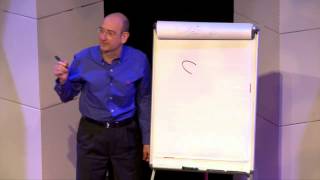
Why People Believe They Can’t Draw — A warm, clear British speaker who asks the audience to draw along — calm pace and simple instructions. Original video on YouTube: Graham Shaw — Why People Believe They Can’t Draw.
Summary
Graham Shaw challenges the belief that drawing is an ability people either possess or lack. He invites the audience to follow a simple sequence of marks and build cartoon faces, then shows how small changes create different characters. The exercise becomes a broader argument about testing limiting assumptions. Shaw does not promise mastery of fine art; he demonstrates an accessible skill and connects it with learning, communication and confidence.
Key points, in order
- The first character begins with a nose, eyes, a smile, an ear and hair, followed by the neck and shirt. Repeating that order gives participants a structure they can remember and reuse.
- Changing the eyes, mouth, hairstyle or accessories produces new personalities. Shaw adds examples such as glasses and a moustache, showing that a small set of marks supports considerable variety.
- He describes using drawings with school students to remember information and with adults to make presentations memorable. A red blood cell carrying oxygen and a boat representing shared effort illustrate these uses.
- A workshop with stroke survivors experiencing aphasia becomes his strongest example. Some participants drew with their non-dominant hand, and he reports their delight and increased confidence. He closes by asking what other beliefs might be worth challenging.
Five useful phrases to practise
Choose a caption line to open Repeat mode. Listen, then say it after the speaker.
- 1:16 One is have an open mind. Are you up for that?
- 2:00 I'll draw the first line, you draw, and when you've done that, look up, and I'll know you're ready for the next line.
- 3:28 you've learned a sequence that would enable you to draw hundreds and thousands of different cartoons,
- 8:23 Hopefully, we've done enough to convince you that in fact we can all draw.
- 14:38 How many other beliefs and limiting thoughts do we all carry around with us every day?
Based on the video’s captions. Original video: Why people believe they can’t draw - and how to prove they can | Graham Shaw | TEDxHull · TEDx Talks.
Everyday phrases from this video
 Graham Shaw — Why People Believe They Can’t DrawStart from the beginning
- Level: B1
- Accent: British
- Length: 15 min · 208 lines to practise
- Speed: about 140 words a minute (an average pace)
- Words: about 2,070; the talk asks 20 questions
- Timing: Sada measures how far behind the speaker you are on every line
What to focus on in this talk
Calm British English with clear, simple instructions. “It’s a little bit like people think of spelling or singing” is a good line for rhythm, and the question tag in “it’s interesting, isn’t it?” falls at the end — typical of British speech.
What this talk trains
Graham Shaw speaks for about 15 minutes: roughly 2,070 words in 208 caption lines. The pace picks up as the talk goes on, from about 116 words a minute in the first quarter to 157 in the last. Overall it is faster than 8 of the other 66 talks on Sada. Its sentences average 9.5 words, no longer than the middle of the library (14.3), and 13.1% of its words fall outside the 3,000 most common English words (library middle: 12.9%). It asks 20 questions, so there is plenty of question intonation to copy. Phrases that fast speech often shortens come up again and again: “going to” (11 times) and “would you” (2 times).
Lines from across the talk, and what each one trains
One line from each quarter of the talk. Press a line to open it in Sada, ready to record. “Linking” marks words that run together: a word ending in a consonant sound joins the vowel that starts the next one.
- 0:50 When I say "draw", I'm not saying we're all going to draw like Michelangelo.
“going to”: fast speech often shortens it to “gonna” when a verb follows. Listen for whether the speaker does here. One of the quicker lines: about 187 words a minute by the caption timing, against 140 for the whole talk.
- 5:00 Now, we'll have some fun with the hair, watch.
Several commas: say it in short chunks first, then as one line. One of the quicker lines: about 182 words a minute by the caption timing, against 140 for the whole talk.
- 10:09 and she said, "Would you come along and do some for our group?"
“would you”: fast speech often shortens it to “wouldja”. Listen for whether the speaker does here. A question: listen to where the voice rises or falls at the end, and copy it.
- 13:01 It's a bit more than that; this sort of activity really builds their confidence."
“sort of”: fast speech often shortens it to “sorta”. Listen for whether the speaker does here. Linking: say “It's a”, “sort of”, “of activity” without a break between the words.
Words that keep coming up
Words outside the 3,000 most common English words that Graham Shaw uses more than once. The number is how often each is said. Look up any you don’t know, then press it to practise the line where it first comes up.
How the pace changes through the talk
| Part of the talk | Words a minute |
|---|---|
| First quarter | 116 |
| Second quarter | 124 |
| Third quarter | 165 |
| Last quarter | 157 |
The fastest minute starts at 9:46 (about 219 words a minute): practise that minute once the rest feels easy. The slowest starts at 2:06 (about 79): a good minute to warm up with.
Measured from the caption timing, so the numbers are close, not exact.
How the talk opens: press any line to practise it
- 0:15 Hi.
- 0:16 I've got a question for you: how many people here would say they can draw?
- 0:23 I think we've got about one or two percent of the hands going up, and it's interesting, isn't it?
- 0:28 It's a little bit like people think of spelling or singing.
- 0:33 They think,"You can either do it, or you can't."
- 0:36 But I think you can.
How to practise this talk
- Warm up on the slowest minute (from 2:06) or on the opening lines above.
- Then take the chosen lines above one at a time: a shortened phrase, a quick line, a line said in chunks, a question, linked words.
- On each line, press Record and say it after Graham Shaw (Repeat) or along with them (Shadow), then open Compare and go again until every word is green.
- Save the fastest minute (from 9:46, about 219 words a minute) for last.
- At one minute a day you finish the whole talk in about 15 days, and Sada shows your first try against your latest.
More talks to practise
Practise again tomorrow? Get one short sentence a day, ready to record in one tap.
You don't need to speak fast.
A slow line to begin with: listen to how “don’t need to” runs together, then say it at the speaker’s pace.
Free · One email a day · Unsubscribe anytime. Confirm your email to start. We keep only your email, language, time zone and where you signed up.