Shadowing Adam Grant
The Surprising Habits of Original Thinkers — Grant discusses how ideas develop through procrastination, doubt and repeated attempts. Business examples and comparisons give practice with explaining why an initial judgement can change. Original video on YouTube: Adam Grant — The Surprising Habits of Original Thinkers.
Summary
Adam Grant revisits his decision not to invest in Warby Parker to explain why original thinkers can look surprisingly ordinary. He initially interpreted the founders’ slow start, doubts, and backup plans as weaknesses. His later research led him to reconsider those judgments. The talk argues that originality can benefit from time to develop ideas, constructive doubt, and a willingness to produce imperfect work. Creativity is presented as a process of exploration and action rather than effortless confidence or constant speed.
Key points, in order
- Grant reports studies in which moderate procrastination supported more creative ideas than either rushing or extreme delay. Starting a problem and leaving it unfinished can allow further possibilities to develop.
- Being first is not his main test of originality. The Warby Parker founders spent time addressing customers’ reluctance to buy glasses online, illustrating the value of improving an existing approach.
- He distinguishes doubting an idea from doubting personal worth. Questioning an early draft or a default choice can prompt experiments and revisions rather than paralysis.
- Originals still experience fear and produce bad ideas. Grant argues that attempting more possibilities increases the chances of valuable work, and that fear of never trying can outweigh fear of an unsuccessful attempt.
Five useful phrases to practise
Choose a caption line to open Repeat mode. Listen, then say it after the speaker.
- 1:17 Originals are nonconformists, people who not only have new ideas but take action to champion them.
- 7:20 Procrastinating is a vice when it comes to productivity, but it can be a virtue for creativity.
- 8:30 So the lesson I learned is that to be original you don't have to be first.
- 10:58 No, it's about being the kind of person who takes the initiative to doubt the default and look for a better option.
- 14:10 But for most of us, if we want to be more original, we have to generate more ideas.
Based on the video’s captions. Original video: The surprising habits of original thinkers | Adam Grant | TED · TED.
Everyday phrases from this video
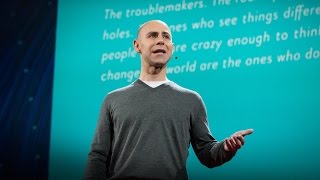 Adam Grant — The Surprising Habits of Original ThinkersStart from the beginning
- Level: B1–B2
- Accent: American
- Length: 15 min · 186 lines to practise
- Speed: about 165 words a minute (an average pace)
- Words: about 2,490; the talk asks 11 questions
- Timing: Sada measures how far behind the speaker you are on every line
What to focus on in this talk
Practise the opening business story, paying attention to the questions and replies.
What this talk trains
Adam Grant speaks for about 15 minutes: roughly 2,490 words in 186 caption lines. The pace picks up as the talk goes on, from about 156 words a minute in the first quarter to 173 in the last. Overall it is faster than 35 of the other 66 talks on Sada. Its sentences average 14.0 words, no longer than the middle of the library (14.3), and 14.2% of its words fall outside the 3,000 most common English words (library middle: 12.9%). It asks 11 questions, so there is plenty of question intonation to copy. Phrases that fast speech often shortens come up again and again: “a lot of” (6 times) and “going to” (5 times).
Lines from across the talk, and what each one trains
One line from each quarter of the talk. Press a line to open it in Sada, ready to record. “Linking” marks words that run together: a word ending in a consonant sound joins the vowel that starts the next one.
- 3:40 So I want to know what happens to the chronic procrastinators.
“want to”: fast speech often shortens it to “wanna” when a verb follows. Listen for whether the speaker does here. One of the quicker lines: about 208 words a minute by the caption timing, against 165 for the whole talk.
- 6:54 When he gets onstage, 11 minutes in,
Linking: say “gets onstage”, “minutes in” without a break between the words. Several commas: say it in short chunks first, then as one line.
- 8:30 So the lesson I learned is that to be original you don't have to be first.
“have to”: fast speech often shortens it to “hafta” when a verb follows. Listen for whether the speaker does here. Linking: say “lesson I”, “learned is” without a break between the words.
- 14:01 Now, you may be wondering, how did this guy become great without doing a whole lot?
A question: listen to where the voice rises or falls at the end, and copy it. Several commas: say it in short chunks first, then as one line.
Words that keep coming up
Words outside the 3,000 most common English words that Adam Grant uses more than once. The number is how often each is said. Look up any you don’t know, then press it to practise the line where it first comes up.
How the pace changes through the talk
| Part of the talk | Words a minute |
|---|---|
| First quarter | 156 |
| Second quarter | 161 |
| Third quarter | 170 |
| Last quarter | 173 |
The fastest minute starts at 11:57 (about 196 words a minute): practise that minute once the rest feels easy. The slowest starts at 2:06 (about 111): a good minute to warm up with.
Measured from the caption timing, so the numbers are close, not exact.
How the talk opens: press any line to practise it
- 0:13 Seven years ago, a student came to me and asked me to invest in his company.
- 0:17 He said, "I'm working with three friends, and we're going to try to disrupt an industry by selling stuff online."
- 0:23 And I said, "OK, you guys spent the whole summer on this, right?"
- 0:26 "No, we all took internships just in case it doesn't work out."
- 0:29 "All right, but you're going to go in full time once you graduate."
- 0:33 "Not exactly. We've all lined up backup jobs."
How to practise this talk
- Warm up on the slowest minute (from 2:06) or on the opening lines above.
- Then take the chosen lines above one at a time: a shortened phrase, a quick line, linked words, a line said in chunks, a question.
- On each line, press Record and say it after Adam Grant (Repeat) or along with them (Shadow), then open Compare and go again until every word is green.
- Save the fastest minute (from 11:57, about 196 words a minute) for last.
- At one minute a day you finish the whole talk in about 15 days, and Sada shows your first try against your latest.
More talks to practise
Practise again tomorrow? Get one short sentence a day, ready to record in one tap.
You don't need to speak fast.
A slow line to begin with: listen to how “don’t need to” runs together, then say it at the speaker’s pace.
Free · One email a day · Unsubscribe anytime. Confirm your email to start. We keep only your email, language, time zone and where you signed up.