Shadowing Tim Urban
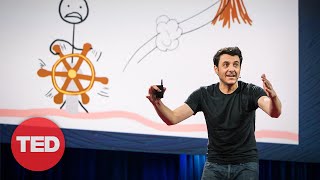
Inside the Mind of a Master Procrastinator — A funny, relaxed talk about the "instant gratification monkey". Natural conversational pace with lots of everyday expressions. Original video on YouTube: Tim Urban — Inside the Mind of a Master Procrastinator.
Summary
Tim Urban uses comic characters to describe the conflict between long-term intentions and the appeal of immediate pleasure. His rushed college thesis and delayed preparation for this talk illustrate a familiar pattern: work remains untouched until fear makes it urgent. The humor then gives way to a distinction between procrastination with deadlines and procrastination without them. Urban argues that the second kind can quietly prevent people from beginning important parts of their lives.
Key points, in order
- The Rational Decision-Maker represents planning and considering the future, while the Instant Gratification Monkey prefers whatever is easy and enjoyable now. Their disagreement explains why a sensible plan does not necessarily lead to action.
- Urban calls guilty leisure in the wrong moment the Dark Playground. A looming deadline or frightening consequence awakens the Panic Monster, temporarily allowing necessary work to take over.
- Responses to his writing revealed frustration far beyond last-minute assignments. Starting a business, caring for health and working on relationships may have no external deadline, so there is no automatic crisis to force progress.
- He finishes with a calendar containing one box for each week of a ninety-year life. Its limited space invites the audience to identify what they are postponing and recognize the cost of continually delaying a start.
Five useful phrases to practise
Choose a caption line to open Repeat mode. Listen, then say it after the speaker.
- 2:40 It was a very, very bad thesis.
- 5:57 We can make long-term plans.
- 6:50 It's where leisure activities happen at times when leisure activities are not supposed to be happening.
- 11:10 But there's a second kind of procrastination that happens in situations when there is no deadline.
- 13:24 We need to think about what we're really procrastinating on, because everyone is procrastinating on something in life.
Based on the video’s captions. Original video: Inside the Mind of a Master Procrastinator | Tim Urban | TED · TED.
Everyday phrases from this video
 Tim Urban — Inside the Mind of a Master ProcrastinatorStart from the beginning
- Level: B1–B2
- Accent: American
- Length: 14 min · 171 lines to practise
- Speed: about 164 words a minute (an average pace)
- Words: about 2,250; the talk asks 13 questions
- Timing: Sada measures how far behind the speaker you are on every line
What to focus on in this talk
Tim Urban talks as if he were chatting with friends: “So, you know —” and “I would kind of do this” are quick and soft, and “kind of” comes out close to “kinda”. The long line about spreading the work out is good practice for keeping up with the speaker without stopping.
What this talk trains
Tim Urban speaks for about 14 minutes: roughly 2,250 words in 171 caption lines. The pace stays fairly even, about 175 words a minute in the first quarter and 164 in the last. Overall it is faster than 33 of the other 66 talks on Sada. Its sentences average 15.8 words, longer than the middle of the library (14.3), and 12.9% of its words fall outside the 3,000 most common English words (library middle: 12.9%). It asks 13 questions, so there is plenty of question intonation to copy. Phrases that fast speech often shortens come up again and again: “going to” (6 times) and “kind of” (4 times).
Lines from across the talk, and what each one trains
One line from each quarter of the talk. Press a line to open it in Sada, ready to record. “Linking” marks words that run together: a word ending in a consonant sound joins the vowel that starts the next one.
- 1:09 So I'd start off light, and I'd bump it up in the middle months,
Linking: say “start off”, “and I'd”, “bump it” without a break between the words. Several commas: say it in short chunks first, then as one line.
- 6:35 an easy and fun place that's entirely out of the Makes Sense circle.
“out of”: fast speech often shortens it to “outta”. Listen for whether the speaker does here. Linking: say “an easy”, “that's entirely”, “out of” without a break between the words.
- 8:32 Do we get what's going to be now happening one day in the future?
“going to”: fast speech often shortens it to “gonna” when a verb follows. Listen for whether the speaker does here. A question: listen to where the voice rises or falls at the end, and copy it.
- 11:10 But there's a second kind of procrastination that happens in situations when there is no deadline.
“kind of”: fast speech often shortens it to “kinda”. Listen for whether the speaker does here. Linking: say “there's a”, “kind of”, “happens in” without a break between the words.
Words that keep coming up
Words outside the 3,000 most common English words that Tim Urban uses more than once. The number is how often each is said. Look up any you don’t know, then press it to practise the line where it first comes up.
How the pace changes through the talk
| Part of the talk | Words a minute |
|---|---|
| First quarter | 175 |
| Second quarter | 165 |
| Third quarter | 152 |
| Last quarter | 164 |
The fastest minute starts at 5:32 (about 201 words a minute): practise that minute once the rest feels easy. The slowest starts at 2:00 (about 131): a good minute to warm up with.
Measured from the caption timing, so the numbers are close, not exact.
How the talk opens: press any line to practise it
- 0:12 So in college, I was a government major, which means I had to write a lot of papers.
- 0:19 Now, when a normal student writes a paper, they might spread the work out a little like this.
- 0:26 you get started maybe a little slowly, but you get enough done in the first week that, with some heavier days later on, everything gets done, things stay civil.
- 0:35 And I would want to do that like that.
- 0:38 That would be the plan.
- 0:39 I would have it all ready to go, but then, actually, the paper would come along, and then I would kind of do this.
How to practise this talk
- Warm up on the slowest minute (from 2:00) or on the opening lines above.
- Then take the chosen lines above one at a time: linked words, a line said in chunks, a shortened phrase, a question.
- On each line, press Record and say it after Tim Urban (Repeat) or along with them (Shadow), then open Compare and go again until every word is green.
- Save the fastest minute (from 5:32, about 201 words a minute) for last.
- At one minute a day you finish the whole talk in about 14 days, and Sada shows your first try against your latest.
More talks to practise
Practise again tomorrow? Get one short sentence a day, ready to record in one tap.
You don't need to speak fast.
A slow line to begin with: listen to how “don’t need to” runs together, then say it at the speaker’s pace.
Free · One email a day · Unsubscribe anytime. Confirm your email to start. We keep only your email, language, time zone and where you signed up.