Shadowing Amy Cuddy
Your Body Language May Shape Who You Are — A clear, well-paced talk on "power poses" and confidence, with plenty of academic vocabulary said simply. Original video on YouTube: Amy Cuddy — Your Body Language May Shape Who You Are.
Summary
Amy Cuddy explores whether body language influences a person's own feelings as well as other people's judgments. She contrasts expansive postures with making oneself small and describes experiments her team conducted on brief posing exercises. The talk connects those reported findings with her personal experience of recovering from a brain injury and feeling like an impostor in academic life. Her proposed practice is private preparation before an intimidating situation, intended to help someone participate more confidently.
Key points, in order
- Cuddy begins with nonverbal communication and the judgments people make from it. Classroom observations then lead her to ask whether adopting a more expansive posture could influence a student's willingness to contribute.
- She reports laboratory findings about perceived power, risk-taking and hormone changes after two minutes in different poses. These are presented as her team's findings and interpretation in the talk.
- A second experiment uses a stressful mock interview. Cuddy says evaluators preferred participants who had prepared with expansive poses, attributing the difference to presence rather than the content or structure of their answers.
- Her recovery and a struggling student's later progress give the argument a personal dimension. She encourages repeated participation until confidence feels internalized, and clarifies that the poses are preparation before an interview, rather than behavior to display to an interviewer.
Five useful phrases to practise
Choose a caption line to open Repeat mode. Listen, then say it after the speaker.
- 2:21 And we make sweeping judgments and inferences from body language.
- 7:23 But our question really was, do our nonverbals govern how we think and feel about ourselves?
- 9:24 But really, power is also about how you react to stress.
- 17:06 Eventually I graduated from college.
- 19:40 Tiny tweaks can lead to big changes.
Based on the video’s captions. Original video: Your Body Language May Shape Who You Are | Amy Cuddy | TED · TED.
Everyday phrases from this video
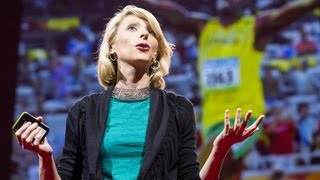 Amy Cuddy — Your Body Language May Shape Who You AreStart from the beginning
- Level: B2
- Accent: American
- Length: 21 min · 300 lines to practise
- Speed: about 178 words a minute (faster than most talks)
- Words: about 3,650; the talk asks 29 questions
- Timing: Sada measures how far behind the speaker you are on every line
What to focus on in this talk
Several phrases in the opening run together: “give it away” sounds like one word, and “what you’re doing” is quick and unstressed. The list “hunching, crossing your legs, maybe wrapping your ankles” is a good drill for clear -ing endings at speed.
What this talk trains
Amy Cuddy speaks for about 21 minutes: roughly 3,650 words in 300 caption lines. The pace picks up as the talk goes on, from about 167 words a minute in the first quarter to 195 in the last. Overall it is faster than 52 of the other 66 talks on Sada. Its sentences average 13.4 words, no longer than the middle of the library (14.3), and 13.1% of its words fall outside the 3,000 most common English words (library middle: 12.9%). It asks 29 questions, so there is plenty of question intonation to copy. Phrases that fast speech often shortens come up again and again: “going to” (18 times) and “want to” (17 times).
Lines from across the talk, and what each one trains
One line from each quarter of the talk. Press a line to open it in Sada, ready to record. “Linking” marks words that run together: a word ending in a consonant sound joins the vowel that starts the next one.
- 2:32 For example, Nalini Ambady, a researcher at Tufts University,
Linking: say “For example”, “researcher at” without a break between the words. Several commas: say it in short chunks first, then as one line.
- 8:37 They actually feel they're going to win even at games of chance.
“going to”: fast speech often shortens it to “gonna” when a verb follows. Listen for whether the speaker does here. Linking: say “win even”, “even at”, “games of” without a break between the words.
- 14:03 So that's what we want to test. Okay?
“want to”: fast speech often shortens it to “wanna” when a verb follows. Listen for whether the speaker does here. A question: listen to where the voice rises or falls at the end, and copy it.
- 15:46 and our behavior can change our outcomes, they say to me, "It feels fake." Right?
A question: listen to where the voice rises or falls at the end, and copy it. Linking: say “and our”, “our outcomes” without a break between the words.
Words that keep coming up
Words outside the 3,000 most common English words that Amy Cuddy uses more than once. The number is how often each is said. Look up any you don’t know, then press it to practise the line where it first comes up.
How the pace changes through the talk
| Part of the talk | Words a minute |
|---|---|
| First quarter | 167 |
| Second quarter | 172 |
| Third quarter | 177 |
| Last quarter | 195 |
The fastest minute starts at 17:15 (about 227 words a minute): practise that minute once the rest feels easy. The slowest starts at 0:59 (about 130): a good minute to warm up with.
Measured from the caption timing, so the numbers are close, not exact.
How the talk opens: press any line to practise it
- 0:15 So I want to start by offering you a free no-tech life hack,
- 0:21 and all it requires of you is this: that you change your posture for two minutes.
- 0:28 But before I give it away, I want to ask you to right now do a little audit of your body and what you're doing with your body.
- 0:35 So how many of you are sort of making yourselves smaller?
- 0:37 Maybe you're hunching, crossing your legs, maybe wrapping your ankles.
- 0:41 Sometimes we hold onto our arms like this.
How to practise this talk
- Warm up on the slowest minute (from 0:59) or on the opening lines above.
- Then take the chosen lines above one at a time: linked words, a line said in chunks, a shortened phrase, a question.
- On each line, press Record and say it after Amy Cuddy (Repeat) or along with them (Shadow), then open Compare and go again until every word is green.
- Save the fastest minute (from 17:15, about 227 words a minute) for last.
- At one minute a day you finish the whole talk in about 21 days, and Sada shows your first try against your latest.
More talks to practise
Practise again tomorrow? Get one short sentence a day, ready to record in one tap.
You don't need to speak fast.
A slow line to begin with: listen to how “don’t need to” runs together, then say it at the speaker’s pace.
Free · One email a day · Unsubscribe anytime. Confirm your email to start. We keep only your email, language, time zone and where you signed up.