Shadowing Steve Jobs
Stanford Commencement Address (2005) — Three stories from his life — connecting the dots, love and loss, and death — told slowly and clearly. One of the most shadowed speeches on the internet. Original video on YouTube: Steve Jobs — Stanford Commencement Address (2005).
Summary
Steve Jobs addresses Stanford graduates through three personal stories about finding direction, losing a role and facing mortality. Rather than offering a linear account of success, he describes events whose significance became clear only later. His college calligraphy class, departure from Apple and cancer diagnosis each support a different reflection on choice. He urges graduates to keep seeking work they care about, remain open to unexpected paths and remember that their time is limited.
Key points, in order
- Jobs explains leaving required college study while continuing to attend classes that interested him. He later connected what he learned about calligraphy with the typography of the Macintosh, an application he had not anticipated as a student.
- Being forced out of Apple initially felt devastating, but he still loved the work. Starting again led to NeXT, Pixar, his family and eventually a return to Apple when it acquired NeXT.
- His third story describes receiving a frightening cancer diagnosis and subsequently learning that surgery was possible. He connects the experience with a longstanding habit of asking whether his daily choices still reflect what matters to him.
- The conclusion warns against allowing other people's expectations to determine one's life. Recalling the farewell message of The Whole Earth Catalog, he encourages curiosity and a willingness to venture beyond familiar paths.
Five useful phrases to practise
Choose a caption line to open Repeat mode. Listen, then say it after the speaker.
- 5:07 Again, you can't connect the dots looking forward; you can only connect them looking backwards.
- 7:12 And so I decided to start over.
- 8:38 If you haven't found it yet, keep looking. Don't settle.
- 9:34 And whenever the answer has been "No" for too many days in a row, I know I need to change something.
- 12:32 Your time is limited, so don't waste it living someone else's life.
Based on the video’s captions. Original video: Steve Jobs' 2005 Stanford Commencement Address · Stanford.
Everyday phrases from this video
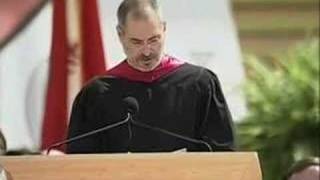 Steve Jobs — Stanford Commencement Address (2005)Start from the beginning
- Level: B2
- Accent: American
- Length: 15 min · 168 lines to practise
- Speed: about 154 words a minute (an average pace)
- Words: about 2,300; the talk asks 4 questions
- Timing: Sada measures how far behind the speaker you are on every line
What to focus on in this talk
Start with “Truth be told I never graduated from college”: Jobs says “truth be told” as one phrase and leans on “never”. The short lines that follow — “That’s it. No big deal.” — are ideal first lines to shadow; copy the pause after each one as much as the words.
What this talk trains
Steve Jobs speaks for about 15 minutes: roughly 2,300 words in 168 caption lines. The pace eases off as the talk goes on, from about 152 words a minute in the first quarter to 128 in the last. Overall it is faster than 28 of the other 66 talks on Sada. Its sentences average 15.3 words, longer than the middle of the library (14.3), and 12.3% of its words fall outside the 3,000 most common English words (library middle: 12.9%). It asks 4 questions, so there is plenty of question intonation to copy. Phrases that fast speech often shortens come up again and again: “want to” (5 times) and “going to” (3 times).
Lines from across the talk, and what each one trains
One line from each quarter of the talk. Press a line to open it in Sada, ready to record. “Linking” marks words that run together: a word ending in a consonant sound joins the vowel that starts the next one.
- 3:14 and I would walk the 7 miles across town every Sunday
Linking: say “and I”, “miles across”, “town every” without a break between the words. A number (7): practise saying it at the speaker’s speed.
- 5:16 You have to trust in something, your gut, destiny, life, karma, whatever.
“have to”: fast speech often shortens it to “hafta” when a verb follows. Listen for whether the speaker does here. Several commas: say it in short chunks first, then as one line.
- 9:30 would I want to do what I am about to do today?"
“want to”: fast speech often shortens it to “wanna” when a verb follows. Listen for whether the speaker does here. A question: listen to where the voice rises or falls at the end, and copy it.
- 11:58 Even people who want to go to heaven don't want to die to get there.
“want to”: fast speech often shortens it to “wanna” when a verb follows. Listen for whether the speaker does here. One of the quicker lines: about 218 words a minute by the caption timing, against 154 for the whole talk.
Words that keep coming up
Words outside the 3,000 most common English words that Steve Jobs uses more than once. The number is how often each is said. Look up any you don’t know, then press it to practise the line where it first comes up.
How the pace changes through the talk
| Part of the talk | Words a minute |
|---|---|
| First quarter | 152 |
| Second quarter | 170 |
| Third quarter | 166 |
| Last quarter | 128 |
The fastest minute starts at 5:48 (about 196 words a minute): practise that minute once the rest feels easy. The slowest starts at 14:13 (about 68): a good minute to warm up with.
Measured from the caption timing, so the numbers are close, not exact.
How the talk opens: press any line to practise it
- 0:07 This program is brought to you by Stanford University.
- 0:10 Please visit us at stanford.edu
- 0:22 Thank You. I am honored to be with you today at your commencement
- 0:30 from one of the finest universities in the world.
- 0:35 Truth be told I never graduated from college
- 0:41 and this is the closest I've ever gotten to a college graduation.
How to practise this talk
- Warm up on the slowest minute (from 14:13) or on the opening lines above.
- Then take the chosen lines above one at a time: linked words, a number, a shortened phrase, a line said in chunks, a question, a quick line.
- On each line, press Record and say it after Steve Jobs (Repeat) or along with them (Shadow), then open Compare and go again until every word is green.
- Save the fastest minute (from 5:48, about 196 words a minute) for last.
- At one minute a day you finish the whole talk in about 15 days, and Sada shows your first try against your latest.
More talks to practise
Practise again tomorrow? Get one short sentence a day, ready to record in one tap.
You don't need to speak fast.
A slow line to begin with: listen to how “don’t need to” runs together, then say it at the speaker’s pace.
Free · One email a day · Unsubscribe anytime. Confirm your email to start. We keep only your email, language, time zone and where you signed up.