Shadowing Brené Brown
The Power of Vulnerability — Storytelling with humour and feeling — great for copying natural intonation and pauses. Original video on YouTube: Brené Brown — The Power of Vulnerability.
Summary
Brené Brown recounts how research into human connection led her toward shame, worthiness and vulnerability. She had wanted to understand and control difficult experiences, but her interviews challenged that ambition. Brown describes people she calls wholehearted as willing to be imperfect and seen as they are. The talk combines her interpretation of qualitative research with a personal account of struggling to accept its implications.
Key points, in order
- Brown characterizes shame as fear of losing connection because something about us seems unworthy. In the interviews she discusses, people with a strong sense of belonging believed they deserved love and connection.
- She identifies courage, self-compassion and authenticity as common qualities among wholehearted participants. They treated vulnerability as necessary, including loving without guarantees and investing in relationships whose outcomes were uncertain.
- These findings conflicted with her own wish to control and predict, leading her to seek therapy. She then examined ways people avoid vulnerability through numbing, certainty, blame and perfectionism.
- Brown argues that numbing difficult emotions also reduces joy and gratitude. She closes by encouraging openness, recognition of our effects on others and an underlying belief that imperfect people remain worthy of love and belonging.
Five useful phrases to practise
Choose a caption line to open Repeat mode. Listen, then say it after the speaker.
- 1:14 I collect stories; that's what I do.
- 7:55 What do these people have in common?
- 9:50 They fully embraced vulnerability.
- 14:13 I lost the fight, but probably won my life back.
- 19:48 And the last, which I think is probably the most important, is to believe that we're enough.
Based on the video’s captions. Original video: The Power of Vulnerability | Brené Brown | TED · TED.
Everyday phrases from this video
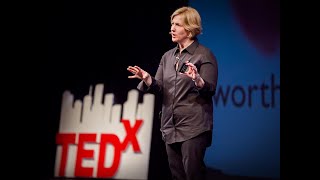 Brené Brown — The Power of VulnerabilityStart from the beginning
- Level: B2
- Accent: American (Texan)
- Length: 21 min · 270 lines to practise
- Speed: about 154 words a minute (an average pace)
- Words: about 3,060; the talk asks 24 questions
- Timing: Sada measures how far behind the speaker you are on every line
What to focus on in this talk
Much of the opening is reported speech: “And I thought, ‘Well, what’s the struggle?’” — copy how her voice shifts when she quotes someone. It is natural, conversational American English with a light Texan warmth.
What this talk trains
Brené Brown speaks for about 21 minutes: roughly 3,060 words in 270 caption lines. The pace eases off as the talk goes on, from about 175 words a minute in the first quarter to 146 in the last. Overall it is faster than 28 of the other 66 talks on Sada. Its sentences average 13.2 words, no longer than the middle of the library (14.3), and 12.8% of its words fall outside the 3,000 most common English words (library middle: 12.9%). It asks 24 questions, so there is plenty of question intonation to copy. Phrases that fast speech often shortens come up again and again: “going to” (15 times) and “want to” (8 times).
Lines from across the talk, and what each one trains
One line from each quarter of the talk. Press a line to open it in Sada, ready to record. “Linking” marks words that run together: a word ending in a consonant sound joins the vowel that starts the next one.
- 1:03 I was like, "Let me think about this for a second."
“let me”: fast speech often shortens it to “lemme”. Listen for whether the speaker does here. Linking: say “think about”, “for a” without a break between the words.
- 6:38 I kind of understood, this is what shame is, this is how it works.
“kind of”: fast speech often shortens it to “kinda”. Listen for whether the speaker does here. Linking: say “kind of”, “this is”, “this is” without a break between the words.
- 13:39 And I said, "Oh my God, this is going to suck."
“going to”: fast speech often shortens it to “gonna” when a verb follows. Listen for whether the speaker does here. Linking: say “And I”, “this is” without a break between the words.
- 17:50 Which just, I hope in 100 years, people will look back and go, "Wow."
Several commas: say it in short chunks first, then as one line. A number (100): practise saying it at the speaker’s speed.
Words that keep coming up
Words outside the 3,000 most common English words that Brené Brown uses more than once. The number is how often each is said. Look up any you don’t know, then press it to practise the line where it first comes up.
How the pace changes through the talk
| Part of the talk | Words a minute |
|---|---|
| First quarter | 175 |
| Second quarter | 157 |
| Third quarter | 136 |
| Last quarter | 146 |
The fastest minute starts at 0:16 (about 196 words a minute): practise that minute once the rest feels easy. The slowest starts at 12:49 (about 94): a good minute to warm up with.
Measured from the caption timing, so the numbers are close, not exact.
How the talk opens: press any line to practise it
- 0:16 So, I'll start with this: a couple years ago, an event planner called me because I was going to do a speaking event.
- 0:22 And she called, and she said, "I'm really struggling with how to write about you on the little flyer."
- 0:27 And I thought, "Well, what's the struggle?"
- 0:30 And she said, "Well, I saw you speak, and I'm going to call you a researcher, I think,
- 0:34 but I'm afraid if I call you a researcher, no one will come, because they'll think you're boring and irrelevant."
- 0:41 And I was like, "Okay."
How to practise this talk
- Warm up on the slowest minute (from 12:49) or on the opening lines above.
- Then take the chosen lines above one at a time: a shortened phrase, linked words, a line said in chunks, a number.
- On each line, press Record and say it after Brené Brown (Repeat) or along with them (Shadow), then open Compare and go again until every word is green.
- Save the fastest minute (from 0:16, about 196 words a minute) for last.
- At one minute a day you finish the whole talk in about 21 days, and Sada shows your first try against your latest.
More talks to practise
Practise again tomorrow? Get one short sentence a day, ready to record in one tap.
You don't need to speak fast.
A slow line to begin with: listen to how “don’t need to” runs together, then say it at the speaker’s pace.
Free · One email a day · Unsubscribe anytime. Confirm your email to start. We keep only your email, language, time zone and where you signed up.