Shadowing Chris Bailey
How to Get Your Brain to Focus — Bailey describes experiments with phone use, distraction and boredom. The captions develop an argument about attention through personal observations and relatively long sentences. Original video on YouTube: Chris Bailey — How to Get Your Brain to Focus.
Summary
Chris Bailey describes reducing his phone use and deliberately spending time on boring activities to explore his own attention. He reports easier concentration, more ideas and more thoughts about the future after adjusting to less stimulation. His central argument is that the craving for distraction can reflect an overstimulated mind. Alongside focused work, he values simple activities that leave enough mental space for thoughts to wander and connect.
Key points, in order
- The first experiment limited his phone to thirty minutes a day for a month. A later experiment involved an hour of deliberately unstimulating activity daily, including reading terms and conditions and watching a clock.
- Bailey links his experiences to research he reviewed about attention switching and novelty. He argues that repeatedly seeking stimulating information can make it harder to remain with one task.
- He calls intentional mind-wandering 'scatter focus' and describes its role in ideas and planning. Knitting, showering, walking between rooms and simply waiting in line are examples of activities that can leave this space.
- His closing challenge is to reduce stimulation for two weeks and observe the result. He suggests device-use limits, regular periods offline and brief moments of boredom, with the emphasis on creating space rather than fitting more activity into the day.
Five useful phrases to practise
Choose a caption line to open Repeat mode. Listen, then say it after the speaker.
- 2:08 First, my attention span grew.
- 4:29 It's not that we're distracted; it's that our brains are overstimulated.
- 11:07 but I love to knit.
- 13:06 We need more space.
- 14:19 Have a disconnection ritual every evening.
Based on the video’s captions. Original video: How to Get Your Brain to Focus | Chris Bailey | TEDxManchester · TEDx Talks.
Everyday phrases from this video
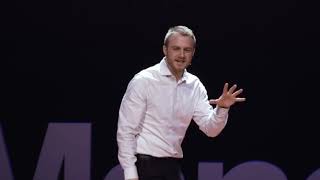 Chris Bailey — How to Get Your Brain to FocusStart from the beginning
- Level: B2
- Accent: Canadian
- Length: 16 min · 197 lines to practise
- Speed: about 164 words a minute (an average pace)
- Words: about 2,570; the talk asks 10 questions
- Timing: Sada measures how far behind the speaker you are on every line
What to focus on in this talk
Practise the passages linking a change in phone use to what he noticed afterwards.
What this talk trains
Chris Bailey speaks for about 16 minutes: roughly 2,570 words in 197 caption lines. The pace stays fairly even, about 165 words a minute in the first quarter and 160 in the last. Overall it is faster than 33 of the other 66 talks on Sada. Its sentences average 19.9 words, longer than the middle of the library (14.3), and 12.2% of its words fall outside the 3,000 most common English words (library middle: 12.9%). It asks 10 questions, so there is plenty of question intonation to copy. Phrases that fast speech often shortens come up again and again: “going to” (3 times) and “want to” (3 times).
Lines from across the talk, and what each one trains
One line from each quarter of the talk. Press a line to open it in Sada, ready to record. “Linking” marks words that run together: a word ending in a consonant sound joins the vowel that starts the next one.
- 1:07 But there was one particular offender out of all of these different devices
“out of”: fast speech often shortens it to “outta”. Listen for whether the speaker does here. Linking: say “particular offender”, “offender out”, “out of” without a break between the words.
- 5:38 And so I thought, "Okay, if the phone had this impact on my attention span,
Linking: say “this impact”, “impact on” without a break between the words. Several commas: say it in short chunks first, then as one line.
- 9:50 And this is, you know, something as simple as you're typing up an email
Linking: say “this is”, “something as”, “up an” without a break between the words. Several commas: say it in short chunks first, then as one line.
- 13:55 How many ideas do you get?
A question: listen to where the voice rises or falls at the end, and copy it.
Words that keep coming up
Words outside the 3,000 most common English words that Chris Bailey uses more than once. The number is how often each is said. Look up any you don’t know, then press it to practise the line where it first comes up.
How the pace changes through the talk
| Part of the talk | Words a minute |
|---|---|
| First quarter | 165 |
| Second quarter | 158 |
| Third quarter | 171 |
| Last quarter | 160 |
The fastest minute starts at 11:07 (about 196 words a minute): practise that minute once the rest feels easy. The slowest starts at 1:52 (about 128): a good minute to warm up with.
Measured from the caption timing, so the numbers are close, not exact.
How the talk opens: press any line to practise it
- 0:06 A few years ago,
- 0:08 I began to observe something in my own behavior
- 0:12 that made me a bit uncomfortable.
- 0:16 And that was that from the moment that I woke up to the end of the day,
- 0:22 my life was a series of screens.
- 0:25 I started the day with the thing that woke me up first thing in the morning, my phone,
How to practise this talk
- Warm up on the slowest minute (from 1:52) or on the opening lines above.
- Then take the chosen lines above one at a time: a shortened phrase, linked words, a line said in chunks, a question.
- On each line, press Record and say it after Chris Bailey (Repeat) or along with them (Shadow), then open Compare and go again until every word is green.
- Save the fastest minute (from 11:07, about 196 words a minute) for last.
- At one minute a day you finish the whole talk in about 16 days, and Sada shows your first try against your latest.
More talks to practise
Practise again tomorrow? Get one short sentence a day, ready to record in one tap.
You don't need to speak fast.
A slow line to begin with: listen to how “don’t need to” runs together, then say it at the speaker’s pace.
Free · One email a day · Unsubscribe anytime. Confirm your email to start. We keep only your email, language, time zone and where you signed up.