Shadowing Patrick Winston (MIT)
How to Speak — A legendary MIT lecture on speaking and presenting. An hour long — shadow it one minute a day. Original video on YouTube: Patrick Winston (MIT) — How to Speak.
Summary
Patrick Winston presents an extensive practical guide to speaking so that an audience can understand, remember and value your ideas. He treats effective communication as a skill improved through knowledge and practice, illustrating his advice throughout the lecture itself. The session covers openings, structure, rooms, visual aids, teaching, technical job talks and endings. Its recurring concern is keeping attention on the ideas and making their significance clear.
Key points, in order
- Winston recommends opening with a promise of what listeners will gain. Repeating key ideas, distinguishing them from similar ideas, announcing transitions and asking well-chosen questions help an audience follow and rejoin the argument.
- He discusses suitable lighting, room size and checking the venue beforehand. Blackboards can control pace, while physical props make demonstrations memorable. Slides should support the speaker with legible, uncluttered material and limited text.
- For teaching, he values visible enthusiasm and stories that help people reason. For research presentations, he recommends explaining the context, rehearsing with people unfamiliar with the work and quickly establishing both a vision and concrete progress.
- His memorability framework combines a symbol, slogan, surprise, salient idea and story. He recommends leaving a clear statement of contributions on the final slide and choosing a deliberate closing gesture or message.
Five useful phrases to practise
Choose a caption line to open Repeat mode. Listen, then say it after the speaker.
- 1:12 What really matters is what you know.
- 5:02 What you want to do instead is start with empowerment promise.
- 14:30 The speed with which you write on the blackboard is approximately the speed at which people can absorb ideas.
- 25:22 There are always too many slides, always too many words.
- 52:27 So you need an idea that sticks out.
Based on the video’s captions. Original video: How to Speak · MIT OpenCourseWare.
Everyday phrases from this video
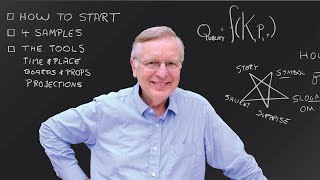 Patrick Winston (MIT) — How to SpeakStart from the beginning
- Level: C1
- Accent: American
- Length: 64 min · 761 lines to practise
- Speed: about 139 words a minute (slower than most talks)
- Words: about 8,740; the talk asks 66 questions
- Timing: Sada measures how far behind the speaker you are on every line
What to focus on in this talk
A university lecture at an unhurried pace, with long, precise sentences. “Your ability to speak, your ability to write, and the quality of your ideas, in that order” is a model of list intonation: the voice rises on each item and falls on the last.
What this talk trains
Patrick Winston (MIT) speaks for about 64 minutes: roughly 8,740 words in 761 caption lines. The pace stays fairly even, about 141 words a minute in the first quarter and 133 in the last. Overall it is faster than 5 of the other 66 talks on Sada. Its sentences average 14.3 words, no longer than the middle of the library (14.3), and 11.7% of its words fall outside the 3,000 most common English words (library middle: 12.9%). It asks 66 questions, so there is plenty of question intonation to copy. Phrases that fast speech often shortens come up again and again: “want to” (20 times) and “have to” (14 times).
Lines from across the talk, and what each one trains
One line from each quarter of the talk. Press a line to open it in Sada, ready to record. “Linking” marks words that run together: a word ending in a consonant sound joins the vowel that starts the next one.
- 3:11 Now, in order to do that, we have to have a rule of engagement, and that
“have to”: fast speech often shortens it to “hafta” when a verb follows. Listen for whether the speaker does here. Linking: say “in order”, “of engagement” without a break between the words.
- 19:06 And the issue is, does it go that way, or does it go that way?
A question: listen to where the voice rises or falls at the end, and copy it. Linking: say “does it”, “does it” without a break between the words.
- 33:00 The first slide with a lot of text on it is an extraction from the 1957--
“a lot of”: fast speech often shortens it to “a lotta”. Listen for whether the speaker does here. Linking: say “lot of”, “text on”, “on it” without a break between the words.
- 54:12 Now, you've got to recognize your collaborators, right?
“got to”: fast speech often shortens it to “gotta” when a verb follows. Listen for whether the speaker does here. A question: listen to where the voice rises or falls at the end, and copy it.
Words that keep coming up
Words outside the 3,000 most common English words that Patrick Winston (MIT) uses more than once. The number is how often each is said. Look up any you don’t know, then press it to practise the line where it first comes up.
How the pace changes through the talk
| Part of the talk | Words a minute |
|---|---|
| First quarter | 141 |
| Second quarter | 143 |
| Third quarter | 141 |
| Last quarter | 133 |
The fastest minute starts at 19:38 (about 193 words a minute): practise that minute once the rest feels easy. The slowest starts at 21:51 (about 62): a good minute to warm up with.
Measured from the caption timing, so the numbers are close, not exact.
How the talk opens: press any line to practise it
- 0:19 PATRICK WINSTON: The Uniform Code of Military Justice
- 0:23 specifies court martial for any officer who sends a soldier into battle without a weapon.
- 0:30 There ought to be a similar protection for students because students shouldn't go out into life without the ability to communicate,
- 0:38 and that's because your success in life will be determined largely by your ability to speak,
- 0:43 your ability to write, and the quality of your ideas, in that order.
- 0:50 I know that I can be successful in this because the quality of communication,
How to practise this talk
- Warm up on the slowest minute (from 21:51) or on the opening lines above.
- Then take the chosen lines above one at a time: a shortened phrase, linked words, a question.
- On each line, press Record and say it after Patrick Winston (MIT) (Repeat) or along with them (Shadow), then open Compare and go again until every word is green.
- Save the fastest minute (from 19:38, about 193 words a minute) for last.
- At one minute a day you finish the whole talk in about 64 days, and Sada shows your first try against your latest.
More talks to practise
Practise again tomorrow? Get one short sentence a day, ready to record in one tap.
You don't need to speak fast.
A slow line to begin with: listen to how “don’t need to” runs together, then say it at the speaker’s pace.
Free · One email a day · Unsubscribe anytime. Confirm your email to start. We keep only your email, language, time zone and where you signed up.